Mesh networks in Argentina: a technology
that deserves our support
Mesh networks open new paths for experimentation, learning and community communications. Bahía Blanca is already taking part, and amateur radio has much to contribute to their development.

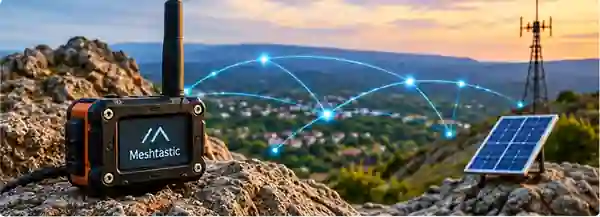
On the National University of the South's Palihue campus in Bahía Blanca, a small solar-powered radio node is part of an experiment worth encouraging. It can exchange messages with compatible devices without relying on a mobile tower or Internet connection. It offers a tangible example of what mesh networks are bringing to Argentina: new ways to communicate, experiment and collaborate.
A simple idea with enormous room for experimentation
In a mesh network, devices need not always rely on a single central station: they can exchange short messages and help relay them. Meshtastic uses low-power LoRa radios; a phone connected over Bluetooth provides the keyboard and display, while messages travel over the air. MeshCore explores a different architecture for links and repeaters. These protocols are not automatically interoperable, but both advance distributed communications. Broadband amateur-radio networks such as AREDN expand this technological field further. Meshtastic · MeshCore.
There is much more to explore than messaging. Antennas, propagation, energy use, solar power, node placement, sensors and relaying methods all provide practical opportunities to learn. Radio amateurs, students, radio clubs and communities can take part with a common aim: making communication more accessible, autonomous and resilient.
Bahía Blanca is already taking part
On August 31, 2026, the National University of the South (UNS) announced an operational solar-powered Meshtastic node at its Agronomy building. It is associated with Sudoeste Mesh, a community initiative that the university links with Bahía Blanca and experiences reaching toward Sierra de la Ventana, Coronel Dorrego, Monte Hermoso and Tres Arroyos.
The UNS highlighted potential applications in weather alerts, environmental data and device tracking. Beyond the installation itself, what stands out is a university supporting a project driven by technical curiosity and collaboration. When experimentation gains community and institutional support, opportunities for learning and progress multiply. Source: UNS.
Projects also exist in other Argentine provinces, using different arrangements and at varying stages of development. In August 2025, ARDC announced a US$57,068 grant for WildfireMesh, supporting equipment, training and field trials with Argentine wildfire response teams. This is a meaningful example of confidence in research and possible public benefit, not a claim about the number of deployed nodes. Source: ARDC.
A new tool for communication and assistance
The ability to send short messages, positions and alerts without relying on mobile infrastructure has understandable appeal. In outdoor activities, areas with limited coverage or emergency situations, a distributed network can offer an additional communications path. Many devices draw little power, and solar-powered nodes make practical endurance and resilience trials possible.
Field tests can improve range, antenna placement, link reliability and operating procedures. The goal is not to promise that a mesh will replace professional emergency communications, but to build and verify an additional capability. That is exactly the kind of contribution an experimental community can make.
Measuring in order to learn and grow
Public maps and regional communities reveal activity worth following. Websites such as SOMesh, which publicly references LW7EEA, let visitors explore observed nodes and connections. There is not yet a sufficiently verified nationwide count of active nodes. Rather than diminishing the project, this offers a useful opportunity to document its growth more thoroughly.
Recording active nodes, delivered messages, link quality, operating time and tested coverage would help operators compare trials, improve configurations and share repeatable findings. In experimentation, measurement is not meant to discourage progress; it is how knowledge advances.
Experimentation is central to amateur radio
Technical investigation is not a marginal aspect of amateur radio: it is part of the service's purpose. Its international definition includes self-training, intercommunication and technical investigations, while Argentina's amateur-radio regulations also recognize learning, study and experimentation. IARU · purpose of the service · Argentine regulations.
With that conviction, LU7DKO.AR supports mesh-network experiments and encourages amateur-radio operators to learn about them, investigate them and contribute to their development. LoRa, Meshtastic and MeshCore offer opportunities to study propagation, design antennas, build nodes, compare protocols and share results. Supporting experimental technology does not mean claiming it has already solved every challenge: it means recognizing its potential and helping realize it.
Radio clubs and universities can play a particularly valuable role by creating spaces for field trials, training and cooperation. Sharing what has been learned — including what did not work — benefits the entire community.
A regulatory framework for responsible experimentation
In Argentina, ENACOM includes 915–928 MHz among the shared-use bands requiring no individual station authorization, subject to applicable technical conditions for equipment and emissions. This framework is distinct from the amateur-radio service, which has its own rules, including station identification requirements and restrictions on encrypted text transmissions. Operators should therefore choose equipment, frequencies and configurations that match the applicable service and check equipment approval requirements where relevant. ENACOM · shared-use bands · Amateur-radio regulations.
Respect for these rules and enthusiasm for experimentation can — and should — go together. Regulation provides a framework for responsible trials, not a reason to turn away from a promising technology.
A technology that deserves our support
Mesh networks offer a genuine opportunity to renew amateur radio's experimental spirit. Their distributed architecture, low power requirements and potential for autonomous installations invite applications that would have been out of reach for many enthusiasts only a few years ago.
Their future will be shaped by people who design, install, measure, document and share. Bahía Blanca's experience and other Argentine initiatives show that individuals and institutions are already willing to take part. This is a good time to bring more stations, knowledge and enthusiasm into the effort.
LU7DKO.AR's editorial position is to support and encourage these initiatives. Not because the research is complete, but precisely because there is so much left to discover. If experimentation is one of amateur radio's core principles, helping mesh networks develop responsibly is a practical way to honor that commitment.
How we reported this story. Desk research drawing on technical, institutional and regulatory sources reviewed as of November 7, 2026. No original interviews or independent propagation measurements were conducted; claims by third parties are attributed.
Sources and further reading
- National University of the South · Palihue node (Aug. 31, 2026)
- ARDC · WildfireMesh grant (Aug. 2025)
- ENACOM · shared spectrum and amateur-radio regulations
- ENACOM · equipment certification
- IARU · definition and purpose of the amateur service
- Meshtastic · official documentation and encryption
- MeshCore · FAQ
- Meshtastic Argentina · regional initiatives and SOMesh · community map
- WildfireMesh · project documentation
Editorial direction: Marcos Kraser · LU7DKO
Published in: Bahía Blanca, Argentina · November 7, 2026
© 2026 Marcos Oscar Kraser · Rights reserved in the original article. External sources and brands remain with their respective owners.