From an Oslo rooftop, a voice opened a new door in space
Norwegian amateur radio operators helped a European experimental satellite interpret a spoken command and act in orbit. Behind the Doom demonstration lay engineering, cooperation and a meaningful technical result.


On a rooftop in Oslo, as an orbiting spacecraft crossed the sky, a voice transmitted over amateur radio reached an unusual listener. There was no other operator at the far end: the receiver was a processor aboard OPS-SAT PRETTY, capable of recognizing a spoken instruction and acting upon it hundreds of kilometres above Earth.
The experiment took place on 27 July 2026. Amateur radio operators from the Oslo Group of the Norwegian Radio Relay League, LA4O, worked with Tanagra Space and teams supporting the European Space Agency's OPS-SAT Space Lab, including spacecraft operations contributors at Graz University of Technology. Its renewed international coverage in November must not be confused with the date of the actual achievement.
A spoken instruction becomes an orbital action
The instruction was to launch Doom, the 1993 video game that has become a familiar demonstration target for unconventional computing platforms. The objective, however, was much more serious than the game: to establish that a satellite could hear radio-transmitted speech, interpret it with an onboard recognition model and respond without the usual precisely formatted digital command sequence.
On the first successful pass on 27 July, recorded synthetic voices were transmitted. On the second pass, at 23:37 Norwegian local time, Jon Bergli Heier (LB9BJ) spoke the instruction into the microphone himself. The spacecraft detected the command, launched the software, and sent back a diagnostic report and a confirmation graphic. The original commemorative image reproduced below is published with the permission of the Oslo Amateur Radio Group (LA4O), with the collaborators credited as requested.
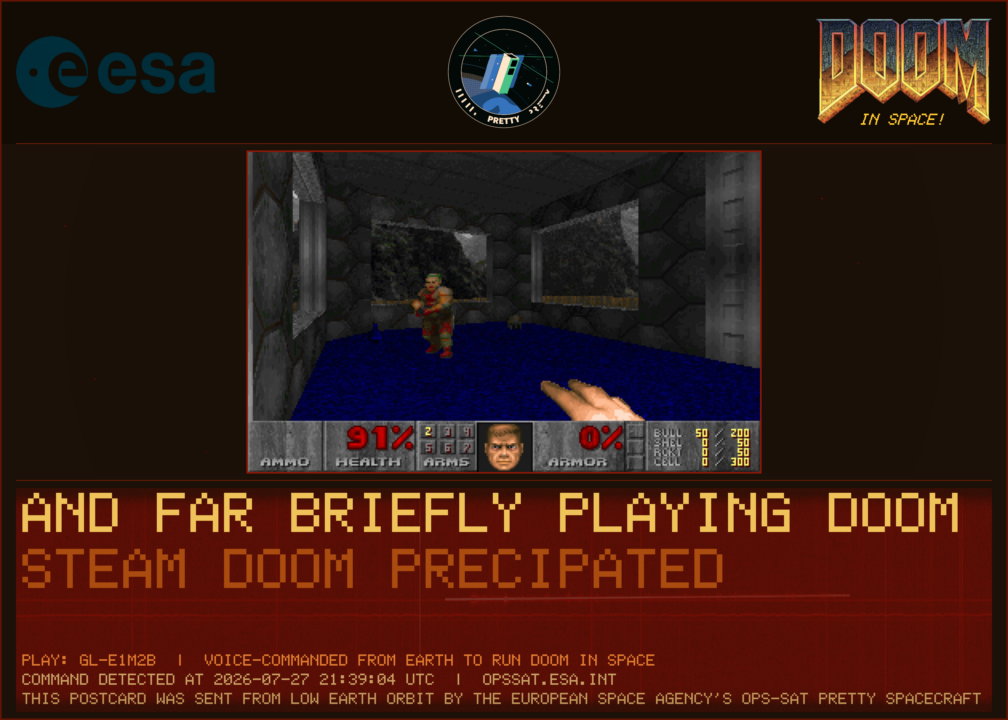
What amateur radio operators brought to the mission
LA4O assembled an uplink station on the 23-centimetre amateur band at 1296 MHz, using an Icom IC-9700, an amplifier and a circularly polarised helical antenna. The operators recorded approximately 80 watts of indicated RF output. This was not a commercial tracking station built around a large engineering budget, but a practical installation developed and tuned by volunteers.

Success was not immediate. Early July recordings showed that the audio captured aboard the satellite was overwhelmed by noise because the receiver was processing a channel much wider than the narrowband FM signal. The Oslo operators analysed the returned I/Q data and identified a practical remedy: identify and shift the carrier, narrow the bandwidth and improve demodulation. Tanagra Space implemented the solution in the onboard software.
That distinction matters. LA4O did more than speak into a radio. Its operators diagnosed a problem in the spaceborne signal chain and helped the international team solve it. Their technical report preserves successful and unsuccessful captures and makes clear which observations are measured and which are inferred.
Small onboard AI, significant implications
The experimental system used software-defined radio and open tools including GNU Radio and Sherpa-ONNX. The onboard speech-recognition model was approximately 27 MB. It did not produce a perfect transcript, but the command detector still identified the relevant instruction.
The key result is not that a video game could run in space — that had been demonstrated previously — but that it was started by human speech transmitted over an amateur radio link. Conventional satellite commands are rigidly defined down to the bit sequence. This test showed a reconfigurable spacecraft responding to a much less predictable real-world signal.
Where the idea might lead
The approach may eventually help spacecraft detect and classify certain radio signals directly in orbit, such as distress calls, unusual RF emissions or specific scientific events, without waiting for all data to be processed on the ground. These are potential future applications, not operational rescue services demonstrated by this experiment, and each would require its own technical and regulatory validation.
The international nature of the project is equally important. LA4O played a decisive role in the ground segment, but Polish amateur operators had made earlier attempts and the eventual result depended on software developers, mission operators and space institutions working together. Reporting the achievement accurately means crediting that complete effort.
Amateur radio still has new frontiers to explore
This story has the qualities of classic radio experimentation: an unlikely objective, a hand-aimed antenna, unsuccessful tests and a solution found by studying actual received signals. It deserves to be understood as a demonstration of what technically disciplined volunteers can contribute to science and engineering.
A rooftop station in Oslo did not create an everyday new method for operating satellites. It proved that a human voice could be transformed into an executable instruction in orbit — and amateur radio operators helped make that possible.
Documentary sources
- LA4O / NRRL — experiment report (9 November 2026).
- LA4O — full technical report (version 1.2, 24 August 2026).
- Tanagra Space — OPS-SAT PRETTY press release (October 2026).
- AMSAT — August 2026 coverage.
Written by Marcos Kraser (LU7DKO) · LU7DKO.AR Amateur Radio News · Bahía Blanca, Argentina, 10 November 2026. Original journalistic text. Third-party images, transmissions, logos and trademarks remain the property of their respective owners.